Published by Elohim USA Team · Houston, TX

If you've ever stood at a truck supply store trying to figure out whether you need ratchet straps or winch straps, you're not alone. Both are essential tools for securing flatbed cargo, but they work differently and are designed for different jobs.
In this guide, we'll break down the real differences so you can choose the right tie-down for your load — and stay DOT compliant on the road.
What Is a Ratchet Strap?
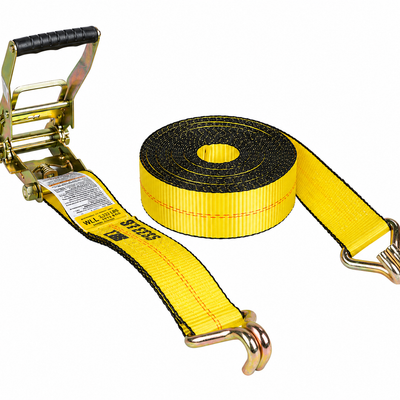
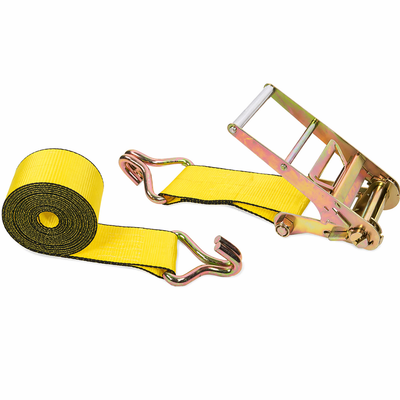
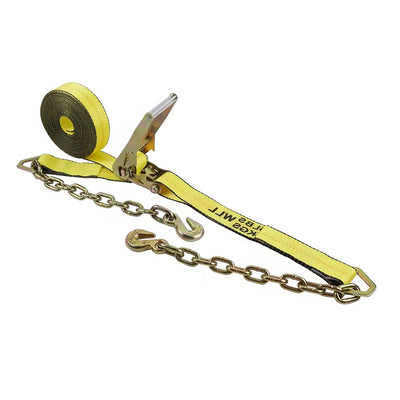
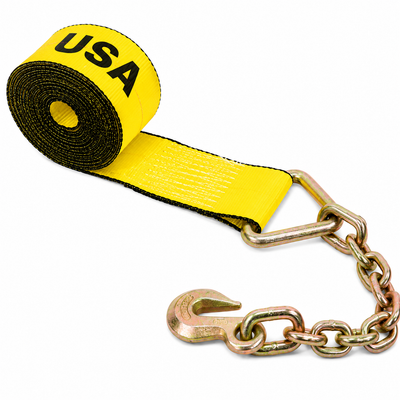
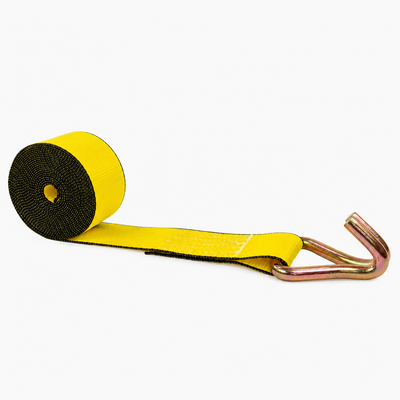
A ratchet strap is a tie-down with a ratcheting mechanism that tightens the strap around your cargo. They come in widths of 1", 2", 3", and 4", with various end fittings like flat hooks, wire hooks, J-hooks, and chain anchors.
Ratchet straps are versatile, easy to use, and don't require any special hardware on your trailer.
Common ratchet strap uses:
- Securing pallets and boxed cargo
- Tying down equipment and machinery
- ATVs, motorcycles, and recreational vehicles
- Construction materials
- Moving and shipping loads

What Is a Winch Strap?
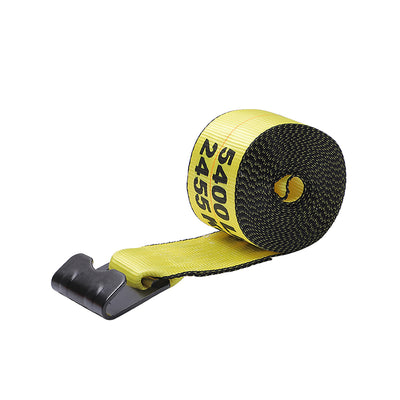
A winch strap works with a winch mounted on your flatbed trailer. The strap is fed through the winch and tightened by rotating it with a winch bar. Winch straps typically come in 2", 3", and 4" widths.
Unlike ratchet straps, winch straps require your trailer to have winches installed. The advantage? They're faster to tighten on heavy loads and provide more consistent tension.
Common winch strap uses:
- Lumber, steel, and pipe loads
- Heavy machinery on flatbeds
- Large industrial cargo
- Any load requiring multiple tie-down points across a flatbed

Key Differences
1. Tightening Mechanism
Ratchet straps use a hand-pumped ratchet handle. Winch straps require a trailer-mounted winch and a winch bar for leverage.
2. Trailer Requirements
Ratchet straps work with any anchor point — D-rings, stake pockets, frame rails. Winch straps require winches on your trailer.
3. Speed
On large flatbed loads with multiple tie-downs, winch straps are significantly faster. Ratchet straps are slower but more flexible for smaller loads.
4. Load Capacity
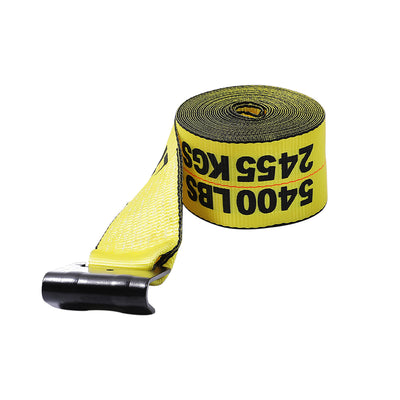
Both come in similar WLL ratings. A 4" ratchet or winch strap with flat hook has a WLL of around 5,400 lbs. The choice often comes down to trailer setup, not capacity.
5. Versatility
Ratchet straps can be used on any trailer and stored in a toolbox. Winch straps are tied to your specific trailer's winch setup.
When to Use a Ratchet Strap
- You don't have winches on your trailer
- You haul smaller or mixed loads
- You need versatility across multiple vehicles
- You're transporting irregular or lighter cargo
When to Use a Winch Strap
- Your flatbed already has winches installed
- You haul long, heavy loads regularly (lumber, steel, pipe)
- Speed matters on large loads
- You're running professional flatbed operations
DOT Compliance — Both Must Meet Standards
Whether you choose ratchet or winch straps, they must meet DOT and WSTDA standards for commercial transport:
- WLL tags must be visible on every strap
- Total tie-down WLL must be at least 50% of cargo weight
- Straps must be free of cuts, burns, and damage
All Elohim USA straps are DOT and WSTDA compliant — so you stay legal on every haul.
How to Choose the Right Width
- 2" straps — Light to medium cargo (~3,335 lbs WLL)
- 3" straps — Heavy-duty cargo (~5,000 lbs WLL)
- 4" straps — Maximum strength flatbed loads (~5,400 lbs WLL)
For most flatbed operations, 4" straps are the industry standard.
Final Verdict
Running professional flatbed with winches? Winch straps are faster and more efficient for heavy loads. Smaller operator or mixed loads? Ratchet straps give you maximum flexibility. Many truckers carry both.
Need DOT-Compliant Cargo Straps?
Shop our complete selection. Free shipping on orders $200+. Bulk & fleet pricing available.
Shop Ratchet Straps Shop Winch Straps